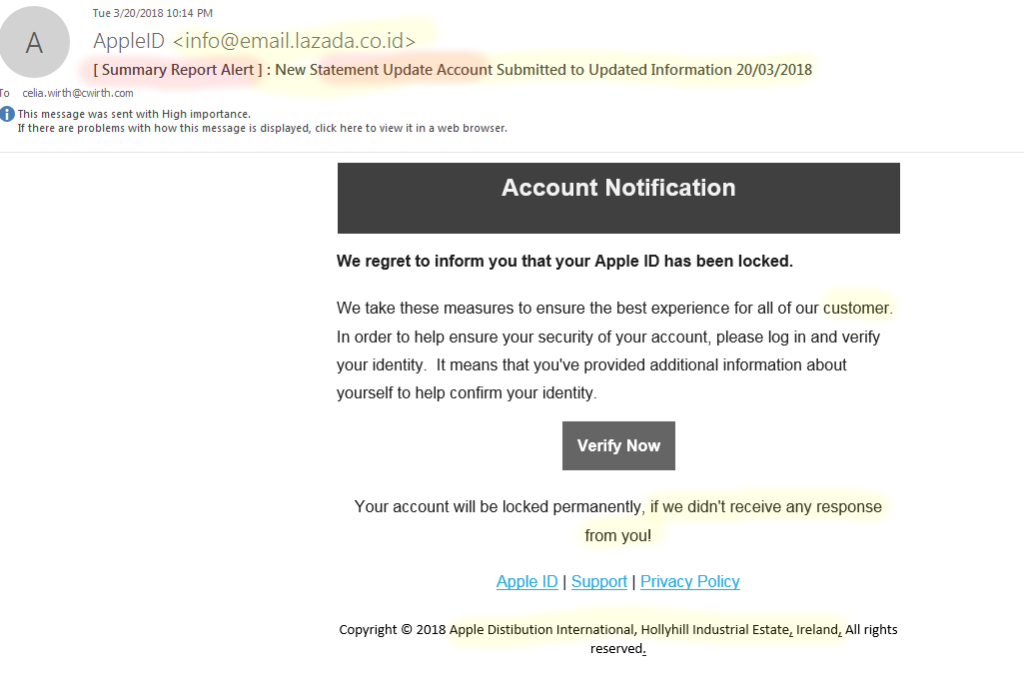
There are lots of different kinds of FAKE emails. I received the one you see below that says it is from Apple.
DO NOT CLICK LINKS IN AN EMAIL unless you know FOR SURE it is real. Instead, go to the internet and LOG DIRECTLY INTO YOUR ACCOUNT.
There are several things you can look at to help you decide if it is real or not:
- You can see the email address associated with the sender “AppleID” is info@email.lasada.co.id. That sure does not look like an email address that Apple would use.
- The subject line is an awkward collection of words that don’t make a lot of sense.
- I do not know what a “Summary Report Alert” is. Even if I had an active Apple ID, I can’t imagine why they would send me an alert about a Summary Report, whatever that is.
- I do not know what a “Statement Update Account” is. And submitting a new one is a bigger mystery.
- The message is not very well written.
- The word at the end of the first sentence is “customer” and should be “customers” (plural).
- The sentence under the Verify Now button ends with”…, if we didn’t receive any response from you!”, which does not make sense in this context.
- Scroll down to the bottom and see that the Copyright is for Apple Distibution International is misspelled.
 I have a fair number of customers who are writers. I also like The Great Courses. A little while ago I got an email from The Great Courses about a class called How to Publish Your Book. And right now it is on sale. Thought I should share.
  TechRepublic, in its “
 Here is a good article from AARP about internet typos that can take you to a fake website. “The usual MO has been to lead consumers to
 Carbonite is the cloud backup I use. Carbonite’s Chris Doggett talks about how: “Cyber threats continue to proliferate at an alarming rate, and everyone who lives in the digital age is more concerned with online security than ever before. Still, there is a gaping security hole putting many people at risk – and it’s one that plenty of users believe they have already covered: Insufficient password protection practices.” Click this title
 I have just gotten the 15th call in the last two weeks from someone who had that big scary message on her computer screen telling her that her computer has a bad problem. In very convincing language it says the computer needs attention and the person should call Microsoft at the phone number provided. There are several types of these messages saying they are from real places like Microsoft, the FBI, and now there is one saying they are from Dell.
 Here is a good summary from AARP